12 Red Animals That Bring the Brightest Color Into the Wild
Red can warn, attract, camouflage, or simply stand out. These red animals carry the color in fur, feathers, skin, shells, and wings.
Red animals are supposed to be loud, right? But in the wild, “red” is less like one uniform paint job and more like a whole wardrobe of tricks, from warning signals to mate-attracting flashes.
It gets messy fast when you realize the same color can show up in totally different ways, scarlet feathers here, rusty fur there, crimson skin or orange-red shells somewhere else. Even the lighting can betray you, since water can filter wavelengths with depth, and a shade that pops in a photo can look muted in real life. Then there are the normal red appearances, like the red panda’s dense reddish fur, which makes “temporary display” a misleading idea.
So when you spot these 12 red animals, you are not just seeing color, you are catching a clue about how each one lives.
What does red do for animals?
Sometimes red is a warning. Sometimes it helps attract a mate. In a few habitats, red can even become difficult to see because water filters wavelengths differently with depth. The same color can therefore be conspicuous in one environment and muted in another.
The Smithsonian’s National Zoo profile of the red panda shows another route: dense reddish fur is simply part of the normal appearance of the species, not a temporary display.
Even the label “red” covers a lot of ground. Scarlet feathers, rusty fur, crimson skin, and orange-red shells can all land in the same visual category while being produced by different pigments, diets, or tissues. The color is useful for grouping animals by appearance, but it does not point to one biological mechanism.
1. Red panda
Red pandas carry rusty red fur across the back and head, with darker legs and a ringed tail. The color works beautifully against mossy branches and autumn-toned vegetation. Their pale facial markings keep the head from reading as one solid block of red.
Seen in its normal habitat, the shade can read very differently from a close-up photo because background, distance, and light all change the contrast.
 commons.wikimedia.org
2. Red fox
Red foxes range from golden orange to deep rusty red, usually with darker legs and pale underparts. Pupperish has followed red foxes closely, including a gentle snuggling pair and a family observed through a full season in the wild in red fox photographs.
The useful detail is that the color is part of a whole body pattern, not an isolated patch of paint, so texture and neighboring markings change how we perceive it.
 commons.wikimedia.org
3. Scarlet ibis
Scarlet ibises can look red from bill to tail, with black appearing only at the wing tips. Their color is linked to carotenoids in the diet. In a flock, the effect is intense enough to make the whole group look like a moving patch of red.
Its appearance also shows why animal color is rarely a fixed visual value. The same body can look brighter, duller, or slightly different in tone as the light changes.
 commons.wikimedia.org
4. Scarlet macaw
Scarlet macaws combine a red head and body with yellow and blue wings. Red dominates the first impression, but the secondary colors keep the bird from looking monochrome. The combination is one reason macaws are among the most recognizable tropical birds.
That makes this species a strong example of how a familiar color can be produced in an unfamiliar biological way rather than by one universal pigment.
 commons.wikimedia.org
5. Northern cardinal
Adult male northern cardinals are bright red with a darker face mask. Females are much browner, which makes the species a clear example of sex-based color difference. Pupperish has also covered a rare half-male, half-female cardinal, where the plumage split created an extraordinary visual contrast.
Up close the color may dominate the animal's appearance, but at a greater distance its outline, movement, and surroundings become just as important as the shade itself.
 commons.wikimedia.org
6. Summer tanager
Male summer tanagers can be nearly red from head to tail, without the black wings seen on scarlet tanagers. One Pupperish profile calls attention to the bird’s strawberry-red plumage, which is about as clean a red bird example as nature offers.
It is a useful contrast with the other species here because the visible color does not necessarily have the same source or purpose even when the final result looks similar.
 commons.wikimedia.org
And if you’re craving high-contrast color, pandas, orcas, and lemurs show how bold black and white patterns work in the wild.
7. Red squirrel
Eurasian red squirrels can range from rusty orange to deep reddish brown. The ear tufts and fluffy tail make the color look especially rich in winter light. Not every individual is equally red, and populations can vary considerably.
The category is therefore visual rather than biological: what links these animals is what we see, not a shared pigment system, habitat, or evolutionary history.
 commons.wikimedia.org
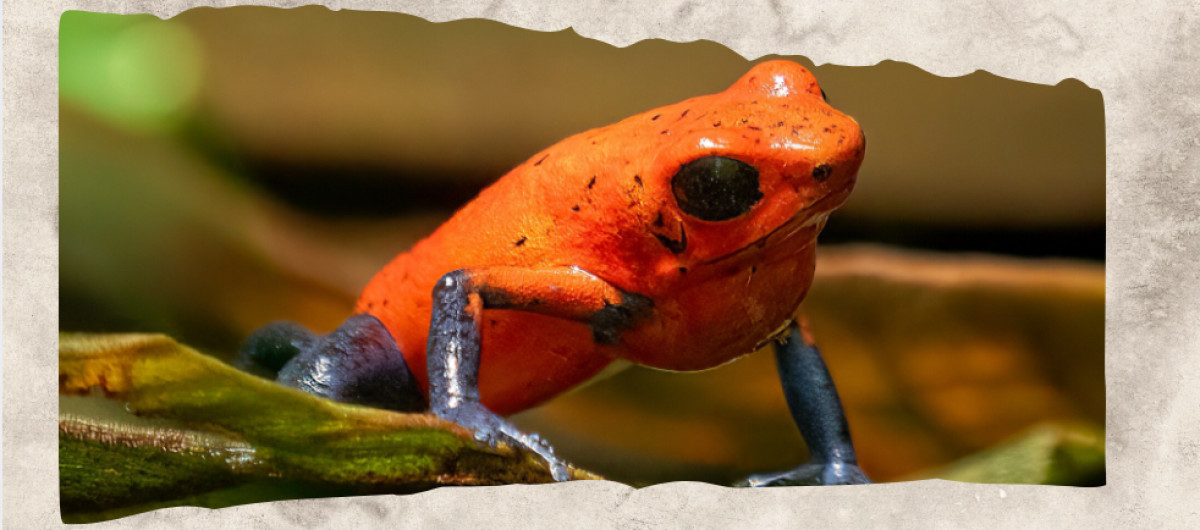
8. Strawberry poison dart frog
Strawberry poison dart frogs often have vivid red or orange skin, although the species includes many color forms. Bright coloration can act as a warning to predators. On a wet tropical leaf, even a tiny frog can become visually dominant.
That distinction matters when comparing photographs, since camera exposure and direct sunlight can exaggerate a color that looks more muted in the wild.
 commons.wikimedia.org
9. Red velvet ant
Despite the name, velvet ants are actually wasps. Many females are covered in dense red or orange hair over a dark body. The bright appearance fits a broader warning strategy, since these insects are well defended.
The effect works because color never appears alone. Shape, movement, surface texture, and the surrounding habitat all change how strongly the animal stands out.
 commons.wikimedia.org
10. Christmas Island red crab
Christmas Island red crabs are famous for the huge seasonal migration that turns roads and forest floors into moving fields of red. A single crab is colorful. Millions moving together change the landscape.
This is one reason the species remains memorable: the color is striking to human eyes, but it still fits into the animal's normal ecology rather than existing just for display.
 commons.wikimedia.org
11. Red salamander
Red salamanders can be vivid red-orange with scattered black spots. The pattern overlaps naturally with animals with spots, but the body color is strong enough that “red” is still the first thing most people notice.
Depending on angle and lighting, the same individual may fall near the edge of the color category, which is common with natural shades that blend into neighboring hues.
 commons.wikimedia.org
12. Tomato frog
Tomato frogs from Madagascar can develop rich red-orange skin, especially in adult females. Their rounded bodies make the color look even more saturated because there is very little pattern to break it up. When threatened, they can inflate themselves and release a sticky skin secretion, adding a physical defense to an already conspicuous appearance.
The broader comparison matters because the visible feature is only the starting point. Habitat, behavior, body structure, and the senses of other animals all influence whether that feature helps with concealment, communication, defense, feeding, or something else entirely.
Taken with the rest of the list, it shows how many unrelated routes can lead to roughly the same visual result in nature.
Not every dark animal stays visually separate from red. A black animal may carry a red patch, bill, eye, or warning mark that completely changes its appearance. Nature is not especially interested in keeping our categories tidy.
 commons.wikimedia.org
First up, the red panda’s rusty red back and head look different depending on whether you are staring at mossy branches or a close-up shot with shifting contrast.
Then the red fox steps in with its golden-to-deep rusty range, where the darker legs and pale underparts change the whole “red” read, not just one patch.
Next, the scarlet ibis turns the flock into a moving red blur, and that carotenoid diet explains why the color can hit like a group performance.
By the time you reach the part about red being hard to see in certain water depths, you realize these animals are working with their environment, not fighting it.
Red is built to get noticed, until the environment changes the rules
On land, bright red often grabs attention. Under water or in heavy shade, the same wavelengths can behave differently, muting the effect. Add diet, pigment chemistry, sexual selection, and warning displays, and “red animal” becomes a surprisingly broad biological group.
That is what makes the color useful for identification but unreliable as an explanation. Two animals can look equally red while arriving at that color through entirely different routes.
Across the examples, the most interesting pattern is the variety behind a shared appearance. Similar-looking features can come from different anatomy, environments, and evolutionary pressures, which is why comparing species side by side reveals more than the visual trait alone.
The “red” you think you see is never the whole story.
Want rare color drama too, like the birds and insects that look purple only in certain light? Read these 12 purple animals.

Damjan