12 Animals With Stripes and the Reasons Their Patterns Work
Stripes can hide, confuse, warn, or identify. These animals with stripes use bands and lines in very different ways.
Some animals wear stripes like they are sending messages, and some wear them like a disguise. The wild part is that the same basic pattern can mean totally different things depending on the animal and the setting.
It starts simple, then gets messy fast: a tiger’s stripes can help it vanish in tall grass and broken forest light, while a plains zebra’s bands shift and blur as it moves. Then you throw in the okapi, which looks zebra-adjacent because of its pale leg and rump stripes, even though it is built more like a giraffe. Same vibe, different reasons, and the “why” changes every time the habitat changes.
Here’s the twist, stripes are not one purpose, they are a whole language.
Why do animals have stripes?
There is no universal answer. A tiger and a coral snake both have stripes, but the same explanation does not fit both animals. In one species the pattern may conceal. In another it may advertise danger. In a third it may help members of the species recognize one another.
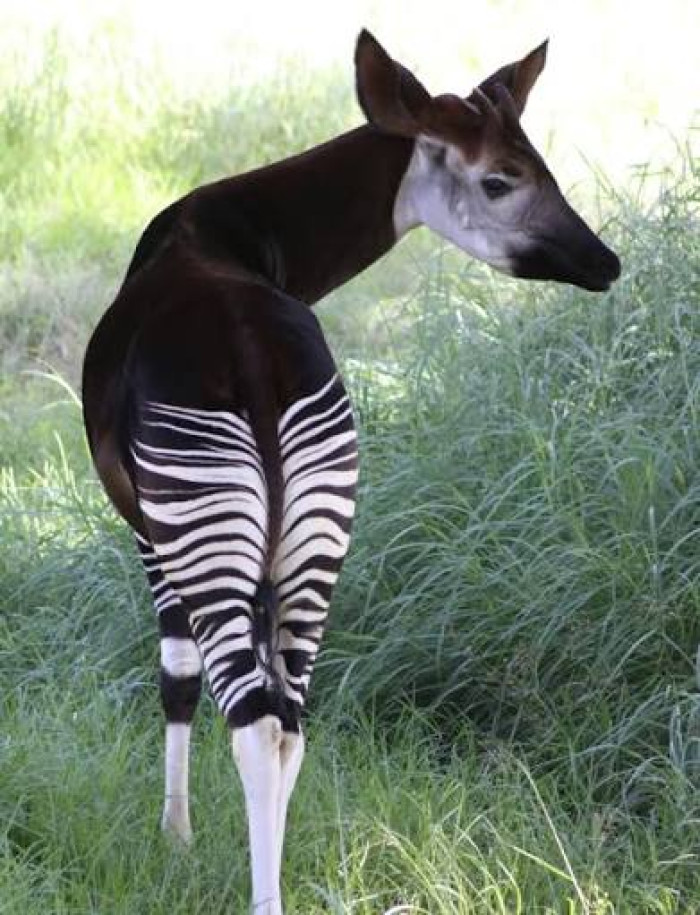
The okapi is a particularly good example of how a stripe pattern can make sense only in context. Smithsonian records note that the animal’s zebra-like leg markings help it blend into dense rainforest, where bands of light and shadow can fragment the outline.
1. Tiger
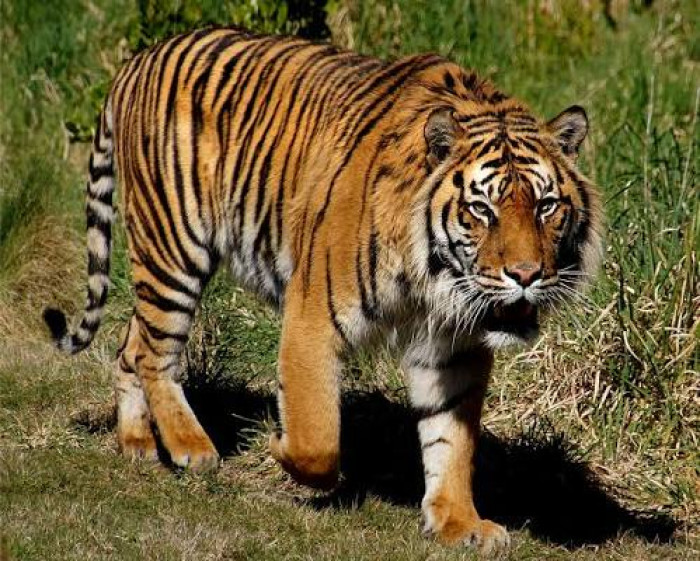
A tiger’s dark vertical stripes cut across an orange coat and continue down the body and legs. In tall grass and broken forest light, that pattern can make such a large cat surprisingly difficult to follow. The stripes also vary from tiger to tiger, giving each animal an individual pattern.
At close range the markings are obvious, yet from farther away repeated shapes can break the body into smaller visual pieces and make the outline harder to read.
 commons.wikimedia.org
2. Plains zebra
Zebras take striping to the extreme. Black and white bands cover almost the entire body, neck, and legs. Pupperish has featured a baby zebra named Modjadji, whose pattern shows that the stripes are present from a very young age.
The pattern is more useful to think about in motion, because lines and patches shift against the background as the animal walks, swims, or turns.
Zebras also overlap naturally with black and white animals. That is a visual overlap, not a reason to make the same article twice.
 commons.wikimedia.org
3. Okapi
The okapi is mostly deep brown, but the legs and rump carry dramatic pale stripes. Those markings make people think “zebra,” even though the okapi is much more closely related to giraffes. The partial pattern is enough to define the animal’s look.
Its markings also show that pattern and color are separate questions: the same layout can work with very different shades and in very different habitats.
 commons.wikimedia.org
4. Striped hyena
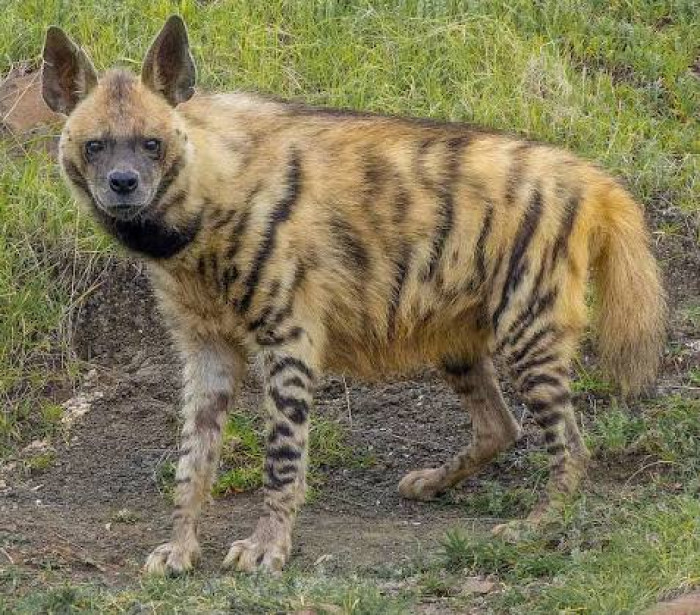
Striped hyenas have dark bands running across a gray or sandy coat, along with a long mane that can be raised. Their stripes are less crisp than a zebra’s, but the broken pattern works well against dry scrub and rocky terrain.
Individual variation can matter too, with spacing, width, or shape changing slightly while the overall pattern remains recognizably typical for the species.
 commons.wikimedia.org
5. Banded mongoose
Banded mongooses carry broad dark stripes across the back. The bands are strongest on the rear half of the body and stand out against grizzled brown fur. In a group, the repeating pattern can make several animals blur together at a glance.
The visual effect depends heavily on scale. What looks like a bold design in a photograph can become surprisingly subtle when the animal is partly hidden by vegetation or shadow.
 commons.wikimedia.org
6. Eastern chipmunk
Chipmunks prove that stripes are not reserved for large exotic mammals. Dark and pale lines run along the back from head toward tail, helping the small animal disappear among leaves, twigs, roots, and broken woodland shade.
That makes the pattern more than decoration. It changes how quickly another animal can detect, identify, or judge the body in front of it.
 commons.wikimedia.org
It’s a lot like snow-disappearing animals and pale, almost-luminous creatures that stand out in nature.
7. Zebra shark
Young zebra sharks have bold light stripes on a darker body, but the pattern changes as they mature and adults become more spotted. That makes the species a literal bridge between stripes and spots over the course of its life.
Compared with a solid coat, repeated markings add visual noise, which can be especially effective in habitats already full of broken light and overlapping shapes.
 commons.wikimedia.org
8. Striped marlin
Striped marlin can show vivid vertical blue bars along the sides of the body. The lines may appear stronger at some moments than others. On such a fast open-water fish, stripes become a very different visual system from the fur patterns seen on land.
The same general pattern can serve different roles in different species, so it is safer to read the markings in context rather than assign one explanation to every animal here.
 commons.wikimedia.org
9. Coral snake
Many coral snakes carry bright repeated bands of red, yellow or white, and black. Their pattern is highly visible and associated with warning coloration rather than concealment. The exact color sequence varies among species.
What stands out to us may function very differently to another animal with different vision, viewing distance, and attention to movement.
 commons.wikimedia.org
10. Banded sea krait
Banded sea kraits are ringed in dark and pale bands from head to tail. The repeated pattern is so clean that the animal can look almost graphic underwater. The pattern also shows that stripes do not need to run lengthwise to count as stripes.
The pattern also creates a useful identification clue, particularly when closely related species differ in the number, width, or placement of their markings.
 commons.wikimedia.org
11. Convict surgeonfish
The convict surgeonfish is pale with several vertical black bars, a pattern that inspired the common name. In a reef setting, those stripes interact with coral shadows, moving water, and groups of other fish rather than grass or tree trunks.
Even a simple-looking pattern becomes more complex once body shape is considered, because stripes or spots wrap around curves and change with posture.
 commons.wikimedia.org
12. Numbat
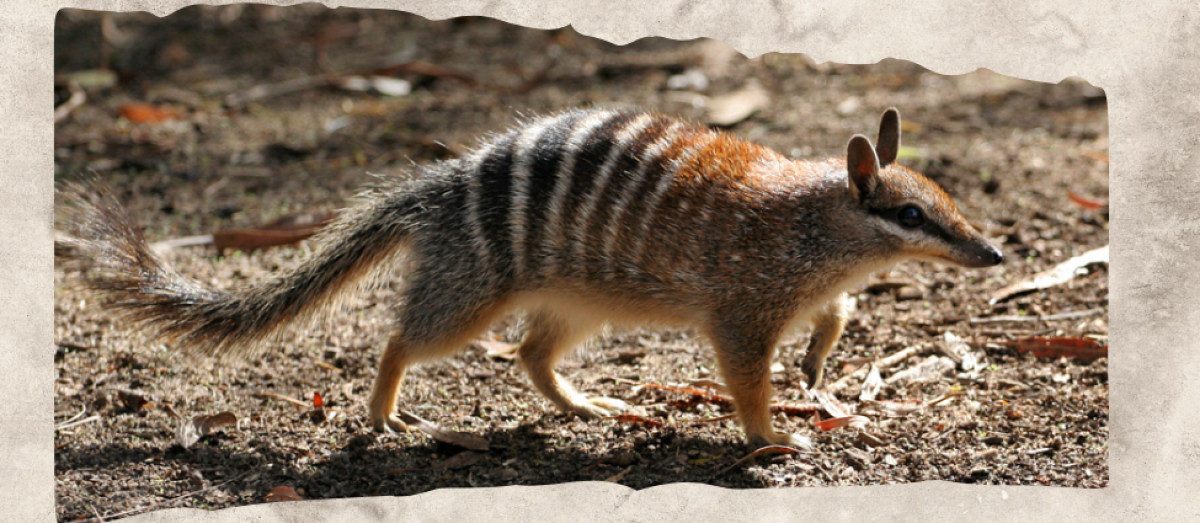
Numbats have reddish-brown coats crossed by white stripes over the back and rump. The pattern becomes denser toward the rear of the body, where it combines with a bushy tail. It is a very different look from the stark bands of a zebra.
Across the list, the recurring theme is not one purpose but one visual solution that has appeared repeatedly in unrelated groups.
Not every striped animal needs a full entry here. Pupperish already has a dedicated article about the lowland streaked tenrec, whose yellow-black stripes sit beside sharp spines. That animal fits equally well among spiky animals, which is exactly why broad appearance clusters need careful separation.
Birds can carry strong stripes too. One Pupperish profile shows a striped woodpecker, while another article collects animals with unusual fur markings. These are useful supporting examples without turning the current page into a duplicate of existing stories.
Stripes also show up alongside physical traits such as horns. Some hoofed mammals combine strong facial or body bands with dramatic horns, which makes appearance-based categories overlap in natural ways.
 commons.wikimedia.org
That tiger trick only works because the stripes repeat and break up the outline when the background is all flickering light and shadows.
Meanwhile, the plains zebra makes the whole thing more intense, since the black and white bands stay bold from baby zebra Modjadji to full-grown motion.
Then the okapi shows how context matters, because its zebra-like leg markings blend into dense rainforest even though it is not a zebra at all.
And just when you think you’ve pinned the pattern down, the striped hyena’s cut-off start in the text is a reminder that this list is not done telling stories.
A stripe is a pattern, not a single adaptation
The main mistake with striped animals is assuming one explanation fits them all. Tiger stripes, zebra stripes, coral snake bands, and fish bars evolved in different ecological settings and can serve different purposes.
What they share is visual repetition. A line across fur, scales, skin, or feathers can change how an animal is seen, whether the goal is to disappear, warn, confuse, or simply be recognized by its own kind.
Across the examples, the most interesting pattern is the variety behind a shared appearance. Similar-looking features can come from different anatomy, environments, and evolutionary pressures, which is why comparing species side by side reveals more than the visual trait alone.
The stripes do not “mean” one thing, they just keep adapting to whatever is trying to see them.
Want more dramatic pattern power, see pandas and orcas proving black-and-white contrast is a survival tool.

Damjan