12 Animals With Spots and the Patterns That Help Them Survive
Rosettes, dots, blotches, and speckles all count. These animals with spots use patterned bodies in forests, grasslands, reefs, and wetlands.
Spots are not just decorative, they are tiny survival blueprints drawn by evolution. One minute they look like random art, the next minute they can help a jaguar vanish in broken light or make a cheetah easier to spot in a blur of grass.
This story started with a simple observation, animals with spots and the patterns that help them survive. But it gets complicated fast, because the same marking can work as camouflage, recognition, or even a predator warning depending on where the animal lives and how light hits its body.
So when you see a rosette, a dot, or those eye-to-mouth “tear marks,” you are really looking at a pattern doing a job.
Why do animals have spots?
Camouflage is one major reason, but not the only one. Spots can also warn predators, help with recognition, or simply result from developmental patterning with no single obvious function.
A Smithsonian National Museum of Natural History animal adaptations guide uses animals such as jaguars and clouded leopards to illustrate how appearance can connect to survival. The important part is context. A pattern that looks loud on a screen may disappear in broken forest shade.
1. Cheetah
Cheetahs carry solid black spots over a tan coat, with dark “tear marks” running from the eyes toward the mouth. Unlike jaguars and leopards, their body spots are mostly simple dots rather than rosettes. The clean pattern helps make them easy to identify.
At close range the markings are obvious, yet from farther away repeated shapes can break the body into smaller visual pieces and make the outline harder to read.
Pupperish has featured several cheetah stories, but this cluster keeps the focus on appearance rather than behavior. That separation helps avoid turning a broad visual article into a duplicate of older individual-animal stories.
 commons.wikimedia.org
2. Jaguar
Jaguars have large rosettes that often contain one or more small spots in the center. That detail is one of the easiest ways to distinguish them from leopards in photos. The pattern is especially effective in dense, broken light.
The pattern is more useful to think about in motion, because lines and patches shift against the background as the animal walks, swims, or turns.
 commons.wikimedia.org
3. Leopard
Leopards also wear rosettes, but the markings are generally smaller and do not usually contain the central dots typical of jaguars. Pupperish has captured the visual contrast between a normal leopard and a melanistic one in a striking leopard and black panther photo.
Its markings also show that pattern and color are separate questions: the same layout can work with very different shades and in very different habitats.
 commons.wikimedia.org
4. Giraffe
A giraffe’s coat is made of large irregular patches separated by pale lines. We usually call them spots even though they are closer to blocks or polygons. The pattern varies by giraffe species and gives each animal a recognizable look.
Individual variation can matter too, with spacing, width, or shape changing slightly while the overall pattern remains recognizably typical for the species. What stands out to us may function very differently to another animal with different vision, viewing distance, and attention to movement.
 commons.wikimedia.org
5. Spotted hyena
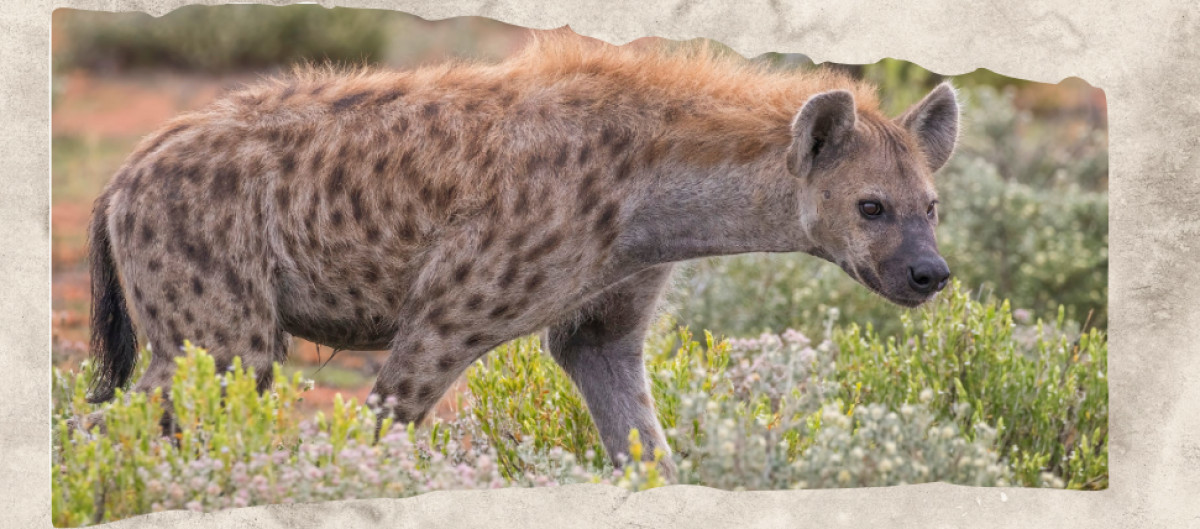
Spotted hyenas carry dark irregular spots over sandy or gray-brown fur. Young animals are much darker and become more visibly spotted as they mature. The rounded body and sloping back make the pattern look completely different from a big cat’s rosettes.
The visual effect depends heavily on scale. What looks like a bold design in a photograph can become surprisingly subtle when the animal is partly hidden by vegetation or shadow.
 commons.wikimedia.org
6. Whale shark
Whale sharks are covered with pale spots and lines across a dark blue-gray body. The arrangement is unique enough that researchers can use photographs of the pattern to identify individuals. It is one of the clearest cases where spots function as a natural visual ID card for human observers.
That makes the pattern more than decoration. It changes how quickly another animal can detect, identify, or judge the body in front of it. The feature becomes especially valuable when light is limited and the animal has less visual information available than a daytime species would.
 commons.wikimedia.org
Spotted cats can be tricky, just like jaguar vs leopard, where rosettes and hunting style tell them apart.
7. Spotted salamander
Spotted salamanders have a dark body with bright yellow or orange spots running along the back. This is the opposite of the tan-and-black camouflage most people associate with spotted mammals. The pattern is bold, clean, and easy to recognize.
Compared with a solid coat, repeated markings add visual noise, which can be especially effective in habitats already full of broken light and overlapping shapes. Across the list, the recurring theme is not one purpose but one visual solution that has appeared repeatedly in unrelated groups.
 commons.wikimedia.org
8. Ladybug
Ladybugs compress the spotted pattern into a tiny shell. Red or orange wing covers are often dotted with black, although the exact number and arrangement vary among species. They also overlap neatly with red animals.
The same general pattern can serve different roles in different species, so it is safer to read the markings in context rather than assign one explanation to every animal here.
 commons.wikimedia.org
9. Ocelot
Ocelots carry a dense mixture of spots, streaks, and rosettes over a golden coat. The pattern becomes especially complex along the sides, where dark markings stretch into chains. It is one of the busiest coats among small wild cats.
What stands out to us may function very differently to another animal with different vision, viewing distance, and attention to movement. The feature becomes especially valuable when light is limited and the animal has less visual information available than a daytime species would.
 commons.wikimedia.org
10. Fallow deer
Many fallow deer retain pale spots into adulthood, unlike most deer species that lose juvenile spotting. Their coat can vary from reddish brown to much darker or nearly white forms, so the spots are only one part of a surprisingly variable appearance.
The pattern also creates a useful identification clue, particularly when closely related species differ in the number, width, or placement of their markings. The feature becomes especially valuable when light is limited and the animal has less visual information available than a daytime species would.
Pupperish has followed another rare spotted deer too. The Visayan spotted deer is a much less familiar species, showing that spotted ungulates extend well beyond the common deer people see in parks.
 commons.wikimedia.org
11. Rusty-spotted cat
The rusty-spotted cat is one of the smallest wild cats, with fine rusty spots and streaks across a grayish coat. Pupperish has covered a pair of rusty-spotted cats and their cubs, where the tiny scale makes the pattern even more noticeable.
Even a simple-looking pattern becomes more complex once body shape is considered, because stripes or spots wrap around curves and change with posture. Individual variation can matter too, with spacing, width, or shape changing slightly while the overall pattern remains recognizably typical for the species.
 commons.wikimedia.org
12. Dalmatian
Dalmatians bring spotting into the domestic animal world. Puppies are born largely white and develop spots as they grow. Each dog’s pattern differs, which is why a distinctive marking such as a heart-shaped Dalmatian nose can become instantly recognizable online.
Across the list, the recurring theme is not one purpose but one visual solution that has appeared repeatedly in unrelated groups. Detecting a sound is only the first step; the animal also needs to compare timing and intensity between the ears to judge direction and distance.
Patterns also cross over into other appearance categories. A jaguar can become a black animal through melanism while still retaining hidden rosettes. A spotted salamander can be mostly dark with bright dots. Even some black and white animals use spots instead of large color blocks.
 commons.wikimedia.org
That’s why the cheetah’s clean black dots and tear marks matter, they look sharp up close and still help break up the outline when it moves away.
Then the jaguar shows up with those big rosettes and central spots, and suddenly you can see how broken forest shade turns a “photo detail” into real camouflage.
Next comes the leopard, with smaller rosettes and no typical central dots, and the whole story shifts again, because the same layout can wear different shades like a disguise.
By the time you reach the giraffe’s spot pattern, the question stops being “why spots exist” and becomes “why this exact pattern works here,” in this exact landscape.
Spots are one of nature’s most flexible patterns
A spot can be a dot, rosette, blotch, patch, or pale mark. It can hide an animal, advertise danger, distinguish one individual from another, or simply become part of the species’ visual identity.
The important part is not the shape alone. It is what that shape does against the habitat around it. The same pattern can disappear in broken shade, become a warning on bright skin, or make one individual recognizable to another.
The next time you spot a rosette or a dot, you will be looking at a survival trick, not just a pretty pattern.
Spots got you curious, now check out animals with stripes and how those bands help them survive.

Damjan