12 Animals With Horns That Turn Their Heads Into Serious Hardware
From spiraled markhor horns to the heavy boss of an African buffalo, these horned animals show how many ways a head can carry a weapon.
A markhor’s horns look like something designed for a dramatic entrance, not just survival. Those long, open spirals can rise off the head and twist outward, turning a simple goat silhouette into a neon sign that says, “This is the main character.”
But the twist is, horns are not one-size-fits-all hardware. A Nubian ibex carries backward-sweeping horns with raised ridges, and suddenly the whole frame looks tiny next to the gear it has to grow and maintain. Then you jump to a bighorn sheep, where massive curls act like both a weapon and a protective shell during head-on clashes. Different animals, different angles, different costs, and totally different reasons for turning their heads into serious equipment.
And once you notice the details, the rest of the horn lineup stops being random and starts feeling like a lineup of very specific fighting styles.
Why do some animals have such huge horns?
There is no single job for a horn. A bighorn ram can smash horns against another ram during competition. An African buffalo uses its heavy horns as a serious defensive weapon. In several antelope species, horn size and shape also help males assess one another before a fight escalates.
That is why animals with big ears and animals with horns can look equally exaggerated for completely different reasons. One feature may improve hearing or heat loss. The other may be built to push, strike, display, or intimidate.
1. Markhor
The markhor wears some of the most dramatic horns of any wild goat. Adult males can develop long, open spirals that rise upward from the head before twisting out. The shape is so distinctive that a silhouette is often enough to identify the animal.
The important point is that horn size alone does not tell us how the structure is used; angle, base thickness, body size, and fighting behavior all matter.
Domestic goats can have impressive horns too, but the markhor takes the basic goat design to a much more theatrical extreme.
 commons.wikimedia.org
2. Nubian ibex
Nubian ibex males carry long horns that sweep backward in a broad arc, with raised ridges along the front. The horns can look oversized on the animal’s compact frame, especially when seen in profile on the steep rocky slopes where ibex live.
A horn also carries a cost. Growing and carrying a large structure requires resources, which is one reason exaggerated forms can reveal a great deal about an animal's life history.
 commons.wikimedia.org
3. Bighorn sheep
Bighorn rams are built around their horns. Mature males develop massive curls that can wrap close to the sides of the head, creating both a weapon and a protective structure during head-on clashes.
Even when horns are rarely used in full combat, they can influence a contest before contact by making size and condition visible to a rival.
The impact is not subtle.
The curled shape also makes bighorn sheep look completely different from many straight-horned antelope, even though both belong in the same broad visual category.
 commons.wikimedia.org
4. Addax
The addax carries slender, spiraling horns that can occur in both sexes. Their long twists rise from a pale desert animal that otherwise has a relatively soft-looking outline, which makes the horns stand out even more.
The shape becomes easier to understand when the animal's usual movements are considered, especially whether it pushes, hooks, twists, or strikes during conflict.
Addax show that dramatic horns also evolved far from mountains and dense grassland. Desert species can carry some of the most elaborate examples.
 commons.wikimedia.org
5. Sable antelope
A sable antelope’s horns curve backward like two dark scimitars. On adult males, they can become especially long and heavily ridged. Combined with the animal’s dark coat and bold face markings, the horns give it one of the strongest profiles among African antelope.
Horns can look symmetrical in profile, but small differences in wear, breakage, and growth often make each adult's pair slightly individual.
If the nose is what catches your attention first in some hoofed mammals, the animals with big noses list goes in a very different direction, from saiga to proboscis monkeys.
 commons.wikimedia.org
6. Ankole-Watusi cattle
Ankole-Watusi cattle are famous for enormous horns that spread outward and upward from the skull. The span can make the animal look almost wider at the head than through the body.
This is a useful example of how a structure can combine defense, competition, and display without serving exactly the same role in every situation.
Cattle already come in a surprising range of shapes and coats, as these cow photos show, but Ankole-Watusi horns are in a category of their own. They are broad at the base and impossible to ignore.
 commons.wikimedia.org
Horn fans will also recognize the showdown energy in moose vs elk, from muzzle shape to branching antlers.
7. White rhinoceros
A rhinoceros horn is structurally different from the hollow-sheathed horns of cattle and antelope. It is formed mainly from keratin rather than growing around a bony core. Visually, though, it is one of the clearest examples of an animal whose head weapon defines its silhouette.
The head and neck have to support the weapon too, so horn evolution is tied to the rest of the body rather than occurring in isolation.
Even a baby rhino already has the unmistakable head shape that will become much more imposing with age.
 commons.wikimedia.org
8. African buffalo
African buffalo carry thick horns that can form a heavy shield, or boss, across the forehead in mature males. From there, the horns curve down and then upward at the tips.
In social species, horns can matter even outside direct fights because other animals can assess them during routine encounters.
They are built for close-range force. A buffalo defending itself from a lion gives some sense of how powerful the entire animal is, horns included.
 commons.wikimedia.org
9. Scimitar-horned oryx
This oryx gets its name from long horns that curve backward like sabers. Both males and females can carry them, giving the species a graceful but armed appearance. Viewed from the side, the horns can seem almost parallel before bending away from the body.
The surrounding habitat can influence what shapes are practical, since extremely wide or branching structures may be harder to carry through dense vegetation.
 commons.wikimedia.org
10. Blackbuck
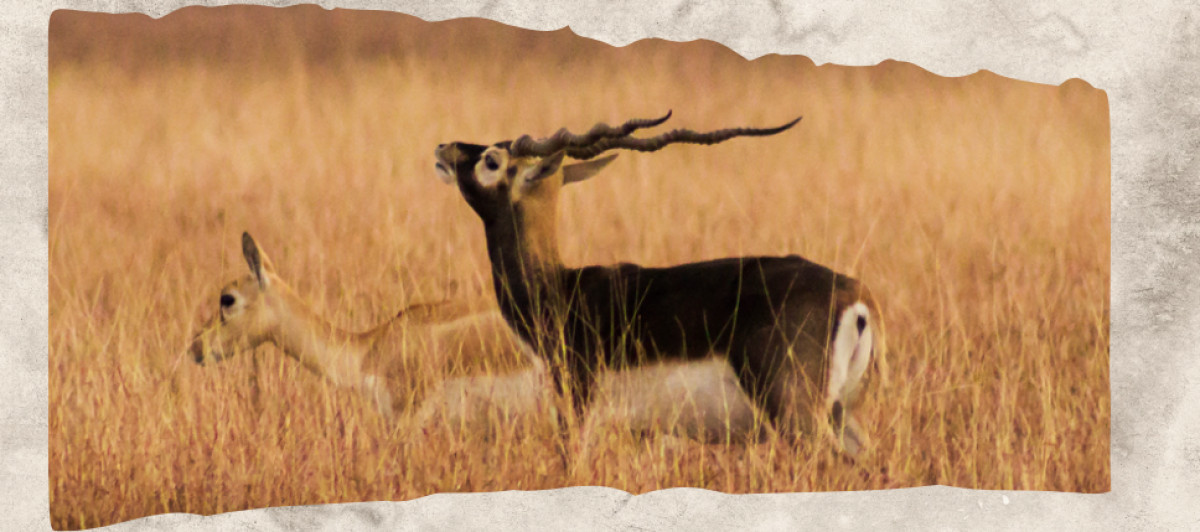
Male blackbuck have ringed horns that twist upward in tight spirals. Their corkscrew shape becomes even more noticeable against the dark coat of a mature male. Females are usually much lighter and often lack horns, creating a strong visual difference between the sexes.
What looks ornamental from a human perspective is therefore often part of a much larger system of movement, competition, and survival.
 commons.wikimedia.org
11. Chamois
Chamois horns are much smaller than those of an oryx or markhor, but their shape is unmistakable. They rise nearly straight before hooking sharply backward at the tips, as if somebody bent the ends with a tool.
The contrast with antlers is useful here: horns are generally permanent structures, so damage and wear can remain visible for years.
Small does not mean boring. This is a good example of how horn shape can be more distinctive than sheer size.
 commons.wikimedia.org
12. Mouflon
Mouflon males can develop thick horns that curl around the sides of the head. The circular sweep resembles the horns of domestic sheep and bighorn sheep, but the proportions and coat pattern give the animal its own look.
Across horned mammals, similar materials have been pushed into remarkably different shapes because the pressures acting on each species are different.
Strong head structures are not always horns. Some spiky animals rely on quills, spines, or armored projections instead, while animals with stripes use a completely different visual feature to stand out or disappear.
 commons.wikimedia.org
That’s why the markhor’s silhouette can be recognizable even before you see the animal clearly.
Next up, the Nubian ibex makes those backward-sweeping horns look even more extreme against its steep rocky backdrop.
Then the bighorn sheep takes over, with curled horns that can wrap near the sides of the head like built-in armor.
And even when the rams do not land full contact, those horn shapes still tip off rivals before the clash ever happens.
Horns come in more shapes than most people realize
Put a markhor, buffalo, rhino, and chamois side by side and the word “horn” suddenly feels very broad. Spirals, hooks, bosses, backward curves, and dense keratin projections all solve different problems and come from different evolutionary histories.
The common thread is that these structures matter. They can change how an animal fights, competes, protects itself, and even how another animal decides whether a confrontation is worth starting.
The horns are not just decoration, they’re the animals’ whole negotiation process before anyone throws a punch.
After you spot the horns, compare a long-haired yak versus a bison’s build in this breakdown of 7 differences.

Damjan