12 Animals With Big Eyes and the Surprising Reasons They Need Them
Huge eyes can help with darkness, distance, hunting, or communication. These big-eyed animals show what an oversized gaze can actually do.
Some animals look like they were built by someone who kept saying, “Bigger. Make it bigger.” Tarsiers, colossal squid, bushbabies, and a whole lineup of other creatures have eyes that are comically large, but the real twist is that big eyes do not automatically mean one thing. More light helps, sure, but the pupil shape, how the retina is arranged, where the eyes sit on the head, and even how the brain processes the image all decide what that eye can actually do.
Now picture the problem each animal is solving. A tarsier has forward-facing eyes it cannot swivel like a camera, so it turns its head like it is hunting for the perfect angle. The colossal squid lives in the deep ocean, where light is scarce and encounters can be rare, so size becomes a survival tool. Meanwhile, bushbabies race through trees at night, so low-light vision has to keep up with their jumps, and their big dark eyes are part of a whole sensory system that has to work fast.
Here’s the surprising part, big eyes show up for totally different reasons.
What do big eyes actually help animals do?
A bigger eye can admit more light, but size alone does not tell the whole story. Pupil shape, retina structure, eye placement, and the animal’s brain all affect what that eye can do. A nocturnal primate needs something different from a deep-sea squid or a bird scanning open ground.
The result is a collection of animals that happen to share one obvious feature without sharing one visual system. Some are almost all eyes.
1. Tarsier
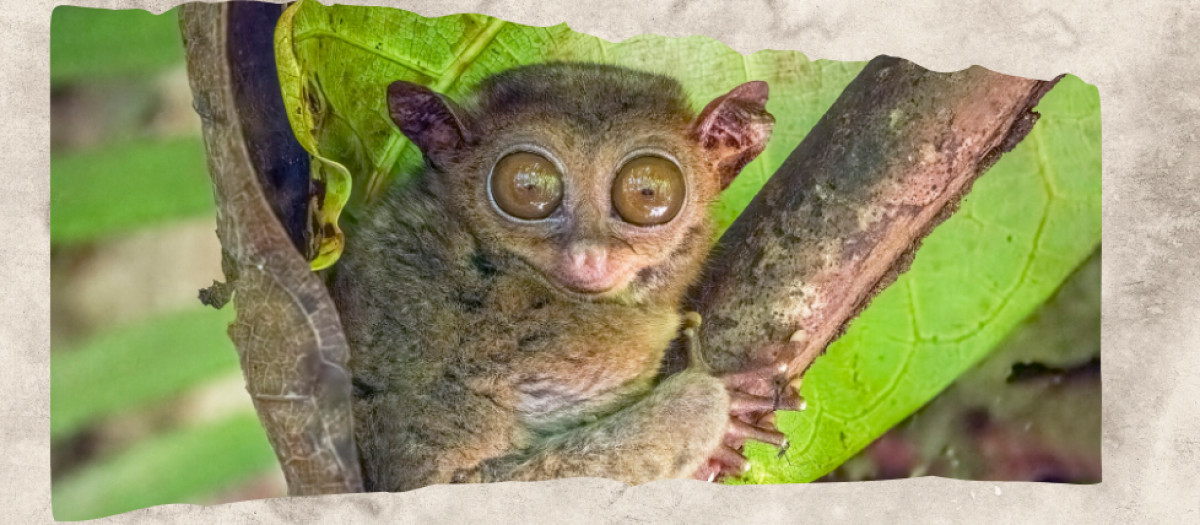
Tarsiers are famous for eyes so large that each one is roughly comparable in size to the animal’s brain. The eyes do not rotate freely in their sockets, so a tarsier compensates by turning its head dramatically to look around.
The advantage is not simply 'better vision.' Larger eyes can favor sensitivity, but resolution, field of view, and low-light performance still depend on the rest of the visual system.
For a small nocturnal primate hunting insects in low light, those huge forward-facing eyes are serious equipment.
 commons.wikimedia.org
2. Colossal squid
The colossal squid has some of the largest eyes known in the animal kingdom. In the deep ocean, where sunlight disappears and encounters may happen at long range, very large eyes can help detect faint light and movement.
Eye placement matters just as much as size, because forward-facing and side-facing eyes solve different problems involving depth, predators, and peripheral awareness.
A filmed encounter with a giant squid shows how striking huge cephalopod eyes look when the animal comes close enough for people to see them clearly.
 commons.wikimedia.org
3. Bushbaby
Bushbabies, or galagos, have enormous dark eyes set into a small face. They are active at night and move rapidly through trees, so low-light vision matters while leaping between branches.
In dim habitats, gathering more light can be valuable, but the animal still relies on neural processing and other senses to turn that light into useful information.
Their big ears are nearly as useful visually, but hearing is another major part of how these nocturnal primates locate prey and stay alert.
 commons.wikimedia.org
4. Slow loris
A slow loris has large forward-facing eyes surrounded by dark markings that make them look even bigger. The animal is nocturnal and moves carefully through branches, relying on vision suited to dim forest conditions rather than high-speed daytime pursuit.
The effect can be especially dramatic on a small head, where the eyes occupy a large share of the face and leave less space for other structures.
That gentle-looking face is deceptive. A slow loris is a highly specialized wild primate, not a plush toy with unusually large eyes.
 commons.wikimedia.org
5. Owl monkey
Owl monkeys are the only truly nocturnal monkeys. Their large eyes dominate the face and support activity during low-light hours. Unlike many nocturnal mammals, they do not rely on a reflective eye layer called a tapetum lucidum, so their visual adaptations took a different route.
Daylight specialists face a different challenge, since large sensitive eyes also need ways to cope with glare and changing brightness.
Different hardware. Same problem.
 commons.wikimedia.org
6. Aye-aye
Aye-ayes combine large eyes with enormous ears, continuously growing incisors, and an extremely thin middle finger used while foraging. Their appearance is almost a checklist of unusual features.
This species shows why eye size should be read together with activity pattern, habitat, and feeding style rather than treated as a single adaptation with one purpose.
The eyes help with nocturnal life, but the full package shows why appearance-based categories overlap. Its dark coat can make the eyes seem even larger, a contrast that also turns up among many black animals.
 commons.wikimedia.org
Big eyes can help, but so can camouflage, like animals with spots and rosettes that break up their outlines.
7. Red-eyed tree frog
Eye size is only part of the red-eyed tree frog’s name story. Those vivid eyes are impossible to miss. When the frog is resting, it can tuck in its bright limbs and keep the eyes closed. If disturbed, opening them suddenly reveals a flash of intense red.
To human observers, large eyes often trigger a cute response, but the biological value lies in what the animal can detect and how quickly it can react.
Color changes the effect completely. Animals in the red animals group can use red for warning, display, camouflage disruption, or simply because that is how their normal pigmentation appears.
 commons.wikimedia.org
8. Tokay gecko
Tokay geckos have large lidless eyes with vertical pupils that can narrow into multiple pinhole-like openings in bright conditions. At night, those eyes are highly sensitive and well suited to the gecko’s active hours.
A large eye can also support better performance at distance in some contexts, although lens shape and retina design determine how much the animal actually gains.
Close up, the pupil is stranger than the eye size.
 commons.wikimedia.org
9. Sugar glider
Sugar gliders have large dark eyes that suit a small nocturnal marsupial moving through trees after sunset. Their eyes also contribute to the juvenile-looking facial proportions humans tend to interpret as cute.
The surrounding sensory system matters too. Hearing, smell, touch, and vision often overlap, so the eyes are only one part of how the animal builds a picture of its environment.
That response is part of why Disney-like animal faces get so much attention, even when the underlying feature evolved for a practical reason rather than to appeal to us.
 commons.wikimedia.org
10. Ostrich
An ostrich has enormous eyes, each around the size of a billiard ball, set high on a long neck. Unlike the nocturnal animals on this list, ostriches are active in open daylight and benefit from excellent long-distance awareness in exposed habitats.
That makes comparisons across species especially useful: similar-looking eyes can be answers to very different visual challenges.
They prove that big eyes are not automatically a night adaptation.
 commons.wikimedia.org
11. Mouse lemur
Mouse lemurs are tiny nocturnal primates with eyes that look disproportionately large on their compact heads. Their size makes the effect especially obvious: most of the face seems devoted to gathering visual information after dark.
The feature also changes the proportions of the skull, which is why some big-eyed animals have such instantly recognizable faces.
They are small enough to disappear into foliage during the day, then become active at night when those eyes matter most.
 commons.wikimedia.org
12. Kinkajou
Kinkajous have round faces and large forward-facing eyes that support their nocturnal life in tropical forest canopies. They also have a prehensile tail and highly mobile body, so vision works alongside touch, balance, and smell as they move through branches.
Seen across the list, oversized eyes are less a single trick than a recurring solution to problems involving light, distance, and detection.
Some animals make one feature their visual signature. Others pile several together. The same is true for animals with big noses, where a conspicuous face can hide very different functions underneath.
 commons.wikimedia.org
The tarsier’s eyes might be about the size of its brain, but since they do not rotate freely, it has to compensate by turning its head dramatically to scan the dark.
Then the colossal squid shows up with eyes so huge they’re built for the deep ocean’s no-sunlight problem, where faint movement is worth detecting from far away.
After that, bushbabies hit the trees at night, and their enormous dark eyes have to catch dim light while they leap around like they’re on a timer.
And that’s when you realize the “big eyes” club is not one shared vision style, it’s a bunch of different survival setups using the same obvious feature.
Big eyes are more than a cute face
The tarsier, ostrich, colossal squid, and red-eyed tree frog do not live alike, hunt alike, or even see the world in the same way. Their large eyes evolved under different pressures, from darkness to open-country vigilance.
That makes the resemblance superficial but useful. Start with the size, then the biology gets much more interesting.
Big eyes are not a flex, they’re the right tool for whatever darkness, distance, or speed an animal has to survive.
Wondering how side-set, horizontal pupils shape grazing life? See sheep eyes versus goat eyes.

Damjan