Hermes: The Messenger of the Gods Who Invented the Lyre as a Baby
By noon on the day he was born, Hermes had invented a musical instrument. By nightfall, he'd stolen his brother's cattle. The gods' messenger started young.
A 28-year-old woman refused to wait at the “wrong” doorway, and by the end of the night she was arguing with a bouncer who swore she had the right entrance. It sounded petty, until she remembered the old warning her grandmother muttered about thresholds, crossing lines, and how some gods do not care about your paperwork, only your timing.
That’s the vibe Hermes brings. He’s the messenger who can move between Olympus, the mortal world, and the underworld like it’s nothing, the god of roads, doorways, and every boundary stone that tells you where you’re allowed to be. But he also has a darker job nobody wants: psychopomp, guiding souls at the edge of life. And if that caduceus on your pharmacy sign feels like medicine, Hermes would be the first to correct you.
Here’s the full story of how one god’s “safe passage” becomes a lesson in what happens when you cross the wrong line.
The Messenger of the Gods
Hermes is best known by a single title: the messenger of the gods. He carried the will of Zeus between Olympus, the mortal world, and the underworld, the only Olympian who could move freely across all three.
That freedom of movement is his defining trait. Hermes was the god of boundaries and of crossing them, of roads, doorways, and thresholds of every kind. His winged sandals, the talaria, let him travel as fast as thought, and his herald's staff, the caduceus, marked him as a protected envoy whose word carried the authority of Zeus himself.
When the gods needed a message delivered, a soul escorted, or a negotiation opened, they sent Hermes, the divine original of the herald. His symbols all trace back to that role:
- The caduceus, a winged staff entwined by two snakes, the mark of the herald
- The talaria, winged golden sandals for impossible speed
- The petasos, the wide-brimmed traveler's hat
- The tortoise, in honor of the shell that became his first lyre
One common mix-up is worth clearing up. The caduceus, Hermes's two-snake staff, is often used today as a medical symbol, but that is an error. The real symbol of medicine is the single-snake Rod of Asclepius. Hermes's staff is about commerce, messages, and safe passage, not healing.
 commons.wikimedia.org
That argument at the doorway is basically Hermes 101, roads and thresholds and all, except the bouncer thinks he’s the one delivering the message.
Then the caduceus detail hits, because everyone wants to call Hermes’ two-snake staff “medicine,” even though it’s about commerce and protected travel.
The Guide of Souls
Hermes had one duty the other Olympians avoided entirely. As psychopomp, the guide of souls, he led the spirits of the dead down to the realm of Hades. He was the escort at the threshold between life and whatever came after, the divine figure who made sure the journey went where it was supposed to.
This is the older, deeper layer of Hermes. Before he was the witty messenger of later myth, he was a god of the boundary stones, the herma, piles of rocks and later carved pillars that marked roads, property lines, and graves across Greece. His very name likely comes from that word. A god who watches over the edge between one place and the next naturally becomes the god who watches over the edge between life and death.
The Greeks poured the last libation of the night to Hermes before sleep, since sleep too is a small crossing into another state. He was also a god of dreams, sending messages up through the boundary of the sleeping mind.
This is similar to Pandora never having a box and Vikings not wearing horned helmets.
The Trickster and Inventor
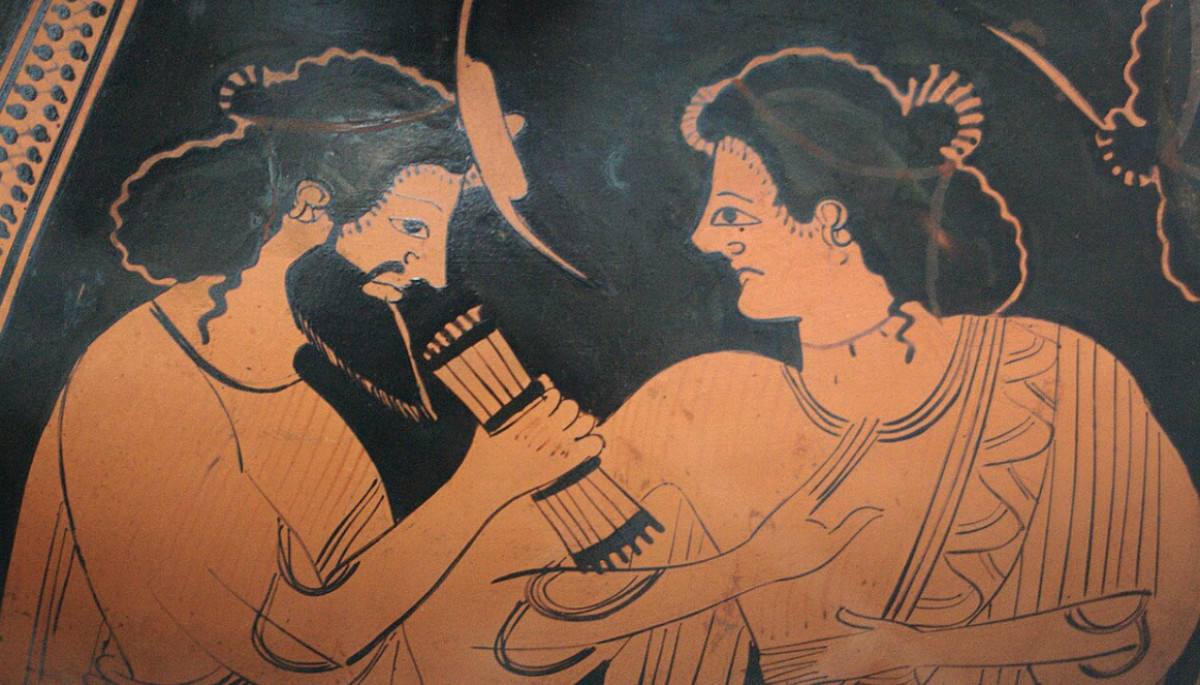
Hermes was the cleverest of the Olympians, and Greek myth credited that cleverness with a long list of inventions. Beyond the lyre, he was said to have devised the panpipes for shepherds, the alphabet, numbers, dice, and even, in some tellings, language itself. The Greek word for interpreter, hermeneus, descends from his name, and so does the modern word hermeneutics, the study of interpretation.
The cattle theft that opened his life set the template. Caught by Apollo and hauled before Zeus, the infant Hermes talked his way out of trouble and then offered his brother the newly invented lyre as a peace gift. Apollo, enchanted by the music, not only forgave the theft but traded his golden herdsman's staff for the instrument. Hermes came out ahead. He usually did.
His most famous feat of cunning was freeing the nymph Io. Zeus had disguised Io as a heifer to hide her from his jealous wife Hera, but Hera set the hundred-eyed giant Argus to guard her, a watchman who never fully slept because only some of his eyes closed at a time. Hermes lulled all one hundred eyes shut with music and stories, then freed Io.
The epithet Argeiphontes, slayer of Argus, stuck to him ever after. His talent for outwitting the sleepless and crossing the uncrossable made him a natural cousin to the tricksters of other traditions, from the Japanese fox spirits to the tricksters of the Norse pantheon.
 commons.wikimedia.org
The plot gets weirder when you remember Hermes is also the guide of souls, the guy who escorts spirits down to Hades right at the boundary.
And suddenly those boundary stones, herma, and carved pillars in Greece feel less like history and more like the reason that doorway conflict would not stay small.
The God Hiding in Modern Life
Hermes never fully left. Because the Romans matched him with their god Mercury, his name landed on a planet and stayed there. His caduceus, misapplied or not, marks hospitals, ambulances, and pharmacies, a symbol that outlived its own meaning.
Delivery and courier companies still borrow his winged image, the natural patron of anyone moving something from here to there, because a god of messages, roads, and swift travel is the obvious patron for anyone in the business of getting something from here to there.
He is the most modern-feeling of the old gods precisely because his domains, communication, commerce, travel, and the crossing of boundaries, are the domains that run the contemporary world. When the Romans rebuilt the Greek pantheon into their own gods, Mercury inherited all of it, and the messenger kept moving.
The other Olympians ruled their domains from a distance. Hermes worked the spaces between them, and those spaces turned out to be where most of life actually happens. The busiest god in mythology stayed busy, which is exactly what you would expect from someone who invented an instrument and pulled off a heist before his first day was over. He remains one of the most retold figures in mythology, the trickster who talked his way onto Olympus and never left.
Read next in this series:
- Roman Gods and Their Greek Counterparts
- Famous Myths From Around the World That People Still Get Wrong
She walked away thinking it was just a bad entrance, but Hermes would call it a boundary lesson.
Wondering who copied whom in the Roman pantheon? Read Jupiter versus Zeus, plus Janus and Mars.