
Japanese Gods: The Shinto Pantheon of 8 Million Kami
Shinto has 8 million gods, and the number isn't literal. It's the old Japanese word for infinity, and it points at a very different idea of the divine.
It starts with a couple, Izanagi and Izanami, playing ocean god with a jeweled spear, and somehow ends with the world going dark because one stormy sibling can’t stop making things worse.
Along the floating bridge of heaven, their story births Japan, then turns into grief and damage control. Izanami dies, Izanagi tries to bring her back from Yomi, and when he returns, he washes off three headline deities like they’re the final boss of the whole pantheon: Amaterasu, Tsukuyomi, and Susanoo. And when Susanoo wrecks Amaterasu’s rice fields, the “chief kami” hides in a cave, forcing the other gods to throw a chaotic party just to get the light back.
That cave trick is where Japanese mythology gets messy, funny, and weirdly personal.
The Creation and the Three Noble Children
Japanese mythology, recorded in the 8th-century Kojiki and Nihon Shoki, texts shaped in part by ideas arriving from mainland China, begins with a couple. Izanagi and Izanami, brother and sister, stand on the floating bridge of heaven and stir the primordial ocean with a jeweled spear. The drops that fall form the first island, and they descend to create Japan and give birth to countless kami.
It ends in grief. Izanami dies giving birth to the fire god, and Izanagi's failed journey to retrieve her from Yomi, the land of the dead, produces the three most important deities in the pantheon when he washes himself clean on returning:
- Amaterasu, the sun goddess, born from his left eye
- Tsukuyomi, the moon god, born from his right eye
- Susanoo, the storm god, born from his nose
These are the Three Noble Children, and the eldest rules everything.
 commons.wikimedia.org
Amaterasu and the Cave
Amaterasu is the sun goddess, the chief kami, and the mythical ancestor of Japan's imperial family, which is why the red disc on the Japanese flag is, in a real sense, her. Her name means "she who shines in heaven."
Her defining myth is the cave. After her brother Susanoo goes on a destructive rampage, wrecking her rice fields, Amaterasu retreats into a cave and seals it, and the world goes dark. The other kami gather outside and stage a raucous, laughing party, hanging a mirror near the entrance.
Curious about the noise, Amaterasu peeks out, sees her own radiance in the mirror, and is drawn far enough that the gods pull her back into the world. Light returns.
That mirror became one of the Three Sacred Treasures of Japan, alongside a sword and a jewel. They still exist, still figure in imperial enthronements, and are never shown to the public, kept hidden in boxes even during the 2019 ceremony for the current emperor. Her shrine at Ise is Japan's holiest, and it is rebuilt identically every twenty years, a cycle of renewal that has run since the 7th century.
 commons.wikimedia.org
The moment Izanagi’s failed Yomi trip turns into the Three Noble Children, the whole pantheon suddenly feels less like distant legend and more like family drama with cosmic consequences.
Then Susanoo goes full menace, wrecking Amaterasu’s rice fields, and her retreat into the cave turns everyone’s “let’s handle this” plan into a high-stakes prank.
Susanoo, Inari, and the Working Gods
And if you’re thinking “endless tails, endless power,” it’s like the nine-tailed kitsune growing new tails with age.
Susanoo
Susanoo, the storm god, is the pantheon's hero and troublemaker at once. Exiled after the cave incident, he redeems himself by slaying the eight-headed serpent Yamata no Orochi to rescue a princess, and from the monster's tail he pulls the sacred sword Kusanagi.
His wild, sea-and-storm temperament made him a god to both fear and thank.
 commons.wikimedia.org
Inari
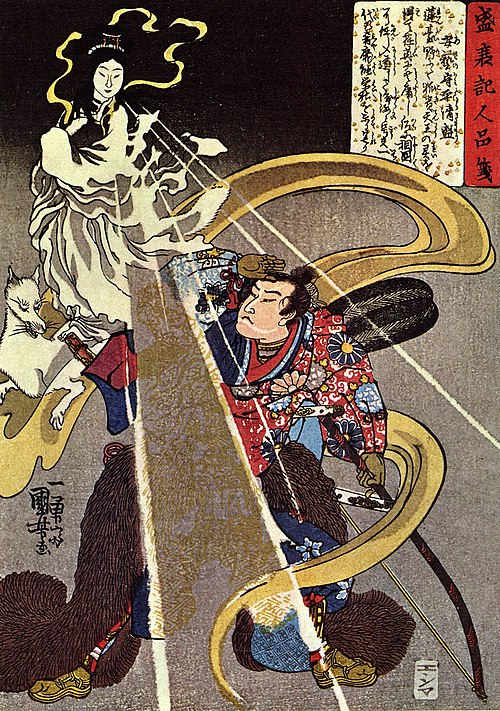
Inari is the kami most woven into daily Japanese life. The deity of rice, prosperity, and business is depicted as male, female, or neither, reflecting the fluidity Shinto allows, and Inari has more shrines than any other kami, around 32,000 of Japan's roughly 80,000. Inari's messengers are foxes, which is why pairs of stone kitsune guard the entrances to Inari shrines, including the famous tunnels of red torii gates at Fushimi Inari in Kyoto.
 commons.wikimedia.org
The gods pull out the mirror, and that’s when the myth stops being just tragic and starts acting like a carefully staged intervention for the sun goddess who’s done with everyone.
After the light returns, that same mirror becomes one of the Three Sacred Treasures, hidden away even during the emperor’s 2019 ceremony, because some miracles are not meant for public viewing.
The wider pantheon assigns a specialist to nearly every human concern:
- Hachiman, god of war and protector of Japan, patron of the samurai Minamoto clan
- Raijin and Fujin, the thunder god and wind god, usually depicted as fearsome demons
- Tenjin, god of scholarship, a deified real person, the scholar Sugawara no Michizane
- Ryujin, the dragon god of the sea
- Tsukuyomi, the moon, who killed the food goddess and was banished by Amaterasu, which is why sun and moon never share the sky
Why Kami Are Not Good or Evil
The most important thing Western readers miss about Shinto is that kami are not divided into good and bad. A kami has two aspects: a gentle, harmonious side and a rough, violent one. The same deity that grants a good harvest can send the typhoon that destroys it. A neglected kami can turn destructive; a destructive force, properly honored, can become a guardian.
This is why Shinto is built around ritual and festival rather than commandment. The point is not to obey the kami but to stay in harmony with them, to keep the rough aspect calm and the gentle one present. It runs through everything from daily ritual to the way a shrine keeps no statue inside, only an invisible presence housed in a mirror or a sword. The same sensibility shaped Japan's abandoned places and haunted corners.
The gods here are less rulers than neighbors, powerful, moody, and everywhere, the same sensibility that fills Japan's folklore with foxes and raccoon dogs who are half-sacred and half-trouble, and links Inari directly to the nine-tailed fox. Eight million of them, which is to say, more than anyone could ever count.
Read next in this series:
Kitsune: The Nine-Tailed Fox That Earns Its Tails
Tanuki: Japan's Shapeshifting Raccoon Dog of Folklore
Famous Myths From Around the World That People Still Get Wrong
Nobody in this family can fix a problem quietly, so the whole world has to hold a party in a cave.
From Izanagi and Izanami’s creation drama to the tanuki stealing a sake bottle, go see.