Scientists Finally Solve Earth’s Greatest Geological Mystery
The missing pieces of the planet’s crust were hiding in plain sight beneath the ice of a frozen world.
Earth has always been a planet full of mysteries, from the origins of life to the unseen depths of its oceans. Over the years, scientists have pieced together a detailed timeline of its history by studying the rock layers that make up its crust.
These layers act like pages in a storybook, each one recording what the planet was like millions or even billions of years ago. But in several places around the world, large sections of this story are missing. It’s as if someone ripped out a few chapters, leaving researchers puzzled for over a century.
This long-standing mystery, known as The Great Unconformity, may have finally been solved, and scientists may have finally figured out where those missing pieces went. The Great Unconformity refers to a massive gap in Earth’s geological record where older rocks suddenly meet much younger ones, with nothing in between to explain what happened.
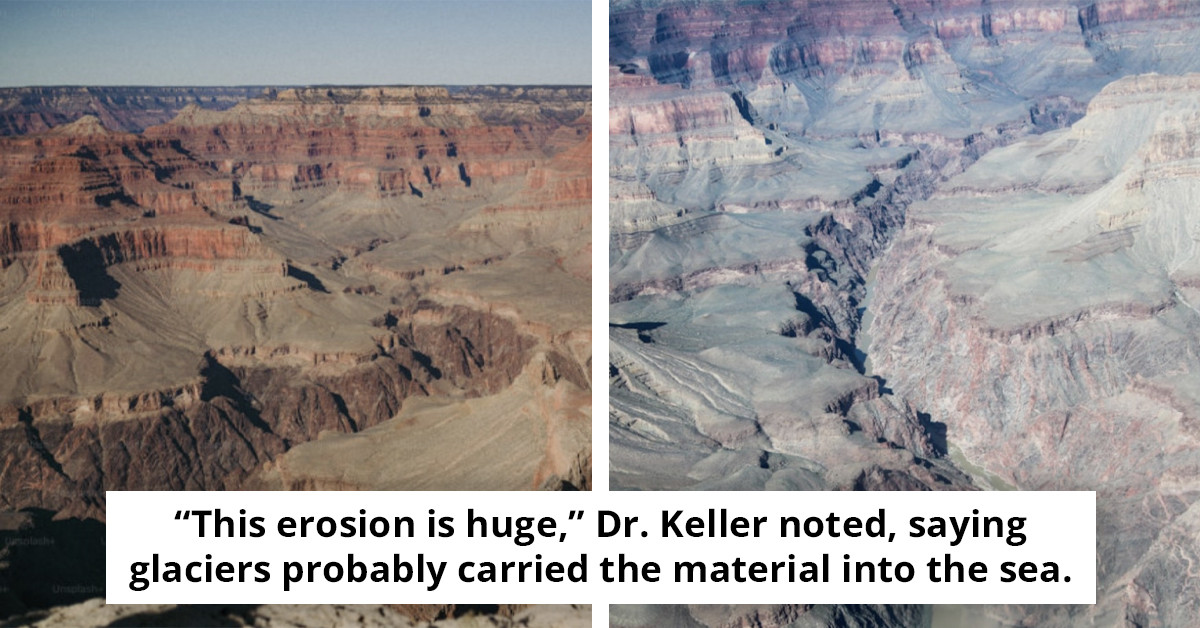
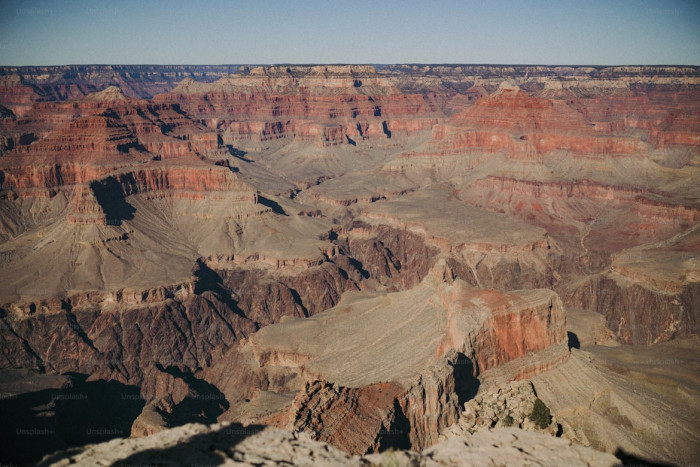
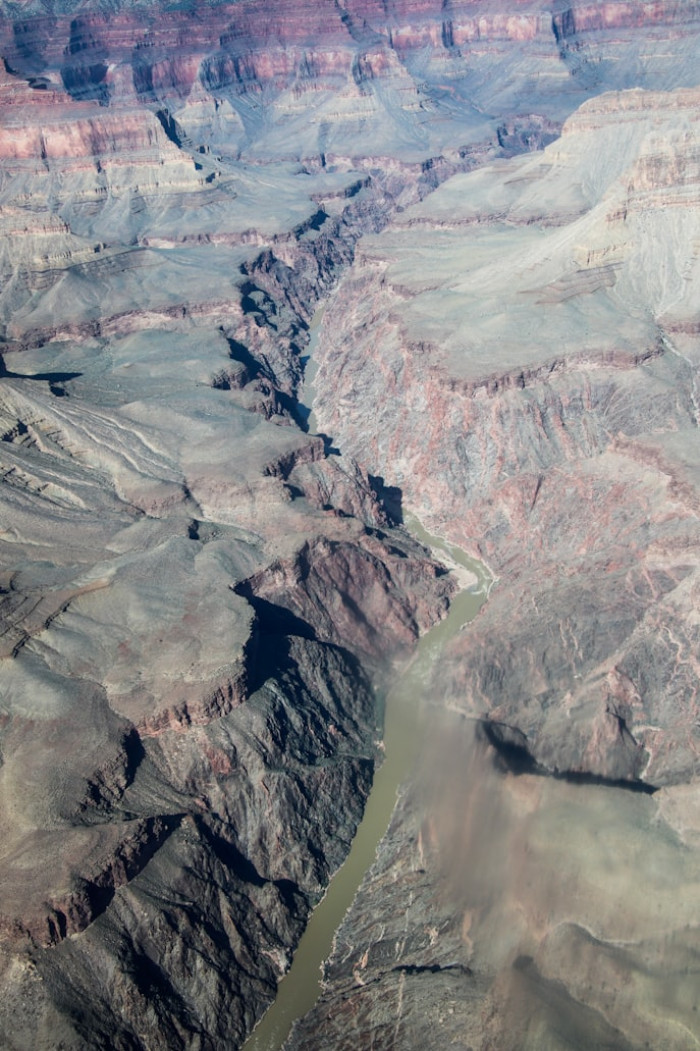
The first major clue appeared in 1869 when geologists at the Grand Canyon noticed something odd: rock layers that should have been separated by millions of years were sitting directly on top of each other. Since then, similar gaps have been identified worldwide, from North America to Africa and beyond. For decades, no one could fully explain how so much of Earth’s crust could simply vanish.
Scientists find that volcanoes didn't erase Earth’s missing crust.
Now, thanks to modern technology and new research, scientists believe they’ve found the answer. According to a recent study, the missing crust wasn’t destroyed by volcanoes or swallowed by tectonic plates; it was scraped away by glaciers during an ancient event known as “Snowball Earth.”
This was a time, hundreds of millions of years ago, when nearly the entire planet was frozen over. Massive glaciers covered continents, grinding down everything in their path and eroding kilometers of solid rock.
 Unsplash
Dr. Brenhin Keller, the study's lead from the Berkeley Geochronology Center, explained just how dramatic this process was. His team calculated that between 3 and 5 kilometers (roughly 2 to 3 miles) of rock were stripped away worldwide.
That’s the equivalent of about one billion cubic kilometers of Earth’s crust gone.
“The scale of this erosion is enormous,” Dr. Keller said, noting that the glaciers likely carried the material into the oceans, where it eventually settled as sediment.
Understanding Geological Mysteries
Dr. Brian Cox, a physicist known for his work in particle physics and cosmology, emphasizes the importance of understanding Earth's geological history. He notes that the newly uncovered crustal fragments beneath ice sheets not only fill gaps in our geological timeline but may also reshape our understanding of plate tectonics.
According to Dr. Cox, the implications extend beyond geology; they could also impact climate science and our understanding of Earth's capacity to host life. He suggests that interdisciplinary collaboration among geologists, climatologists, and biologists is essential for a holistic understanding of these discoveries.
Scientists traced ancient crystals to confirm massive glacial erosion during Snowball Earth.
To reach this conclusion, researchers examined tiny crystals containing hafnium and oxygen isotopes. These isotopes act like chemical fingerprints, revealing where the crystals originated and the conditions under which they formed.
The data suggested that many of these crystals had been eroded from older continental rocks and redeposited in new layers at lower temperatures. In simple terms, the evidence fits perfectly with the idea of glacial erosion during Snowball Earth.
 Unsplash
This theory also helps explain another geological puzzle: why there are so few asteroid impact craters older than 700 million years. If glaciers really did strip away several kilometers of rock, it makes sense that any craters from before that period would have been erased along with the rest of the surface.
What’s fascinating about this discovery is not just how much of the planet’s crust was lost, but how it reshaped Earth’s surface and possibly influenced the conditions that came after. The massive erosion likely exposed new minerals and nutrients, which could have affected ocean chemistry and even early life.
So, while we may never recover those missing “chapters” of Earth’s story, scientists now have a clearer idea of what happened to them.
The rocks weren’t destroyed; they were simply relocated, ground down by glaciers, and carried off to the sea. The Great Unconformity, once one of geology’s biggest mysteries, is finally starting to make sense.
Climate scientists stress that the unearthing of these crustal pieces could offer insights into Earth's past climate conditions. Dr. Katharine Hayhoe, a prominent climate scientist, suggests that analyzing these geological formations can reveal how ancient environments reacted to climate changes.
Hayhoe recommends that scientists utilize advanced technologies, such as geospatial data analysis, to further investigate these regions. By combining geological findings with climate data, researchers can better predict future climate trends and their potential impacts on global ecosystems.
Analysis & Recommendations
As we uncover the mysteries of Earth's geology, the collaboration of experts from various fields becomes ever more critical. Insights from physicists like Dr. Brian Cox and climate scientists such as Dr. Katharine Hayhoe remind us that understanding our planet's history can inform not just geological studies but also climate science and ecological preservation.
Future research should focus on integrating these discoveries with real-time climate data to develop predictive models that can inform conservation efforts. By doing so, we can create a more sustainable future while respecting the intricate histories of our planet.

Damjan