Haunted Places in Pennsylvania: Eastern State, Gettysburg, and More
Civil War ghosts handing out live ammunition, an asylum that scarred a generation, and a bloody handprint that won't wash off.
Gettysburg is supposed to be history you walk through, not a place that grabs you by the collar and refuses to let go. Over three days in July 1863, the battlefield swallowed roughly 51,000 soldiers, and the ground still feels like it is holding its breath.
Now picture it like this, visitors drift from Devil’s Den to Little Round Top, snapping photos near the granite where sharpshooters died, only to swear they catch figures that were not there a second ago. Others say the air smells like gunpowder on calm days, then they head to the Jennie Wade House, where the only civilian killed during the battle died while baking bread. And if that is not enough, the Farnsworth House Inn is basically a sleepover with the past, since it was used by Confederate sharpshooters and later as a field hospital.
It gets even stranger when you realize the battlefield has rules, because it is a cemetery, not a stage.
Gettysburg: Pennsylvania's Most Haunted Ground
Over three days in July 1863, roughly 51,000 soldiers were killed, wounded, or went missing at Gettysburg National Military Park. It remains the deadliest battle ever fought on American soil, and it is also considered the single most haunted location in the state, possibly the country.
The reports cluster in specific spots. Devil's Den, a jumble of granite boulders where sharpshooters died, is where visitors most often photograph figures that were not there when the shutter clicked. At Little Round Top, people describe the smell of gunpowder on still days.
The Jennie Wade House honors the only civilian killed during the battle, struck by a stray bullet while baking bread. The Farnsworth House Inn, used by Confederate sharpshooters and later as a field hospital, now rents rooms to people who want the full experience.
Out of respect, no ghost tours are permitted on the battlefield itself. It is a cemetery, not an attraction.
 commons.wikimedia.org
Eastern State Penitentiary
No list of haunted places in PA skips Eastern State. Opened in Philadelphia in 1829, it pioneered total solitary confinement and slowly drove many of its inmates insane. Al Capone served time there and reportedly begged a ghost to leave his cell alone.
The cellblocks still produce reports of footsteps and disembodied laughter, and the prison's full grim history is covered among the broader most haunted places in America.
 commons.wikimedia.org
That rule about no ghost tours on the battlefield is exactly why people keep hunting for signs at Devil’s Den and Little Round Top instead.
The Abandoned Asylums of Pennsylvania
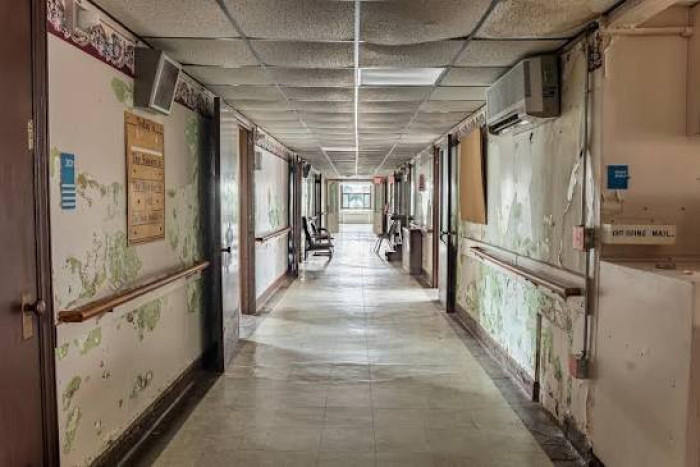
Pennsylvania built institutions on a massive scale, then abandoned them. The results are some of the eeriest sites in the state.
Pennhurst State School, in Spring City, opened in 1908 and was exposed in a 1968 television investigation for shocking neglect of disabled residents. It closed in 1987 after a landmark civil rights case.
 commons.wikimedia.org
Dixmont State Hospital near Pittsburgh is gone now, but its morgue was long reported to be patrolled by something that frightened anyone who entered.
 commons.wikimedia.org
Hill View Manor in New Castle, a former poor farm built in 1926, has appeared on Ghost Hunters and Ghost Adventures.
 commons.wikimedia.org
Then you leave Gettysburg and head straight to Eastern State Penitentiary, where the same kind of “too quiet” cellblock stories follow you in.
Speaking of eerie rituals, this is similar to the stranger who left roses and cognac at Edgar Allan Poe’s grave.
The moment you hear about footsteps and disembodied laughter in the old solitary confinement wings, the abandoned asylums start to feel like the next chapter, not a detour.
The same forces that make these places frightening also make them photogenic, which is why Pennsylvania's abandoned hospitals turn up in so much urban exploration photography. The institutions are crumbling. The stories about them keep growing.
Jim Thorpe and the Molly Maguires
In the town of Jim Thorpe, formerly Mauch Chunk, the Old Jail Museum preserves a piece of labor history that doubles as a ghost story. In 1877, members of the Molly Maguires, a secret society of Irish coal miners, were hanged here after a series of controversial trials.
One of the condemned men, Alexander Campbell, reportedly pressed his hand against the wall of cell 17 and swore the mark would stay as proof of his innocence.
The handprint is still on the wall. Staff say it has been painted over and scrubbed repeatedly. It keeps coming back.
 commons.wikimedia.org
And when you connect Pennhurst’s 1908 neglect scandal and Dixmont’s long-rumored morgue patrol with Hill View Manor’s unfinished mention, the whole state starts to feel like one long haunting.</p>
Seven Gates of Hell and Pennsylvania's Ghost Stories
Not every legend holds up, and Pennsylvania has plenty that do not. The Seven Gates of Hell in Hellam Township is the most famous. The story claims an asylum once burned down in the woods, that gates were built to trap the escaping patients, and that anyone who passes the fifth gate is never seen again.
No such asylum ever existed. The legend persists anyway, which says something about how badly people want the woods to be haunted.
Other genuine sites fill the gaps. The General Wayne Inn near Philadelphia, a favorite haunt of Edgar Allan Poe in life, has reported poltergeist activity for generations. Cemeteries across the state lean on the same Victorian fascination with death that shaped how 19th-century Pennsylvanians buried and mourned their dead.
Pittsburgh, Centralia, and the Rest of the State
The hauntings are not confined to the battlefields and asylums. Pittsburgh keeps its own roster. Inside the Cathedral of Learning at the University of Pittsburgh, the Early American Room holds belongings once tied to Martha Jane Poe, a relative of Edgar Allan Poe, and staff report items shifting and shadows moving along the walls. Clayton, the preserved mansion of steel magnate Henry Clay Frick, is said to hold at least two female spirits.
Even Church Brew Works, a century-old Catholic church converted into a brewery, comes with a woman in white who reportedly objects to what her sanctuary became. Then there is Centralia.
A coal seam beneath the town caught fire in 1962 and never stopped burning. The ground cracked, smoke rose from the streets, and the federal government eventually condemned the entire borough. Almost everyone left.
Today a handful of residents remain in what is effectively a smoldering American ghost town, its abandoned roads slowly being reclaimed. Centralia is not haunted in the traditional sense. It is something rarer. A place where the disaster never ended.
Why Pennsylvania Is So Haunted
A catastrophic battle. A century of brutal institutions. Mining towns that boomed and died. Pennsylvania did not become one of the most haunted places in America by accident. It became that way because an unusual amount of suffering happened here and was carefully recorded.
The neighboring haunted places in Ohio and the asylum legends of haunted places in Kentucky follow the same logic. Institutions, war, and industry left their mark across the whole region.
The ghosts are a matter of belief. The history is a matter of record.
You came for a spooky stop, but Pennsylvania keeps turning every location into a scene.
Want more deadly hauntings, like the plantation where the dead reportedly never checked out?